

Studio Hire London: How to Avoid Overtime Penalty Fees in 2026

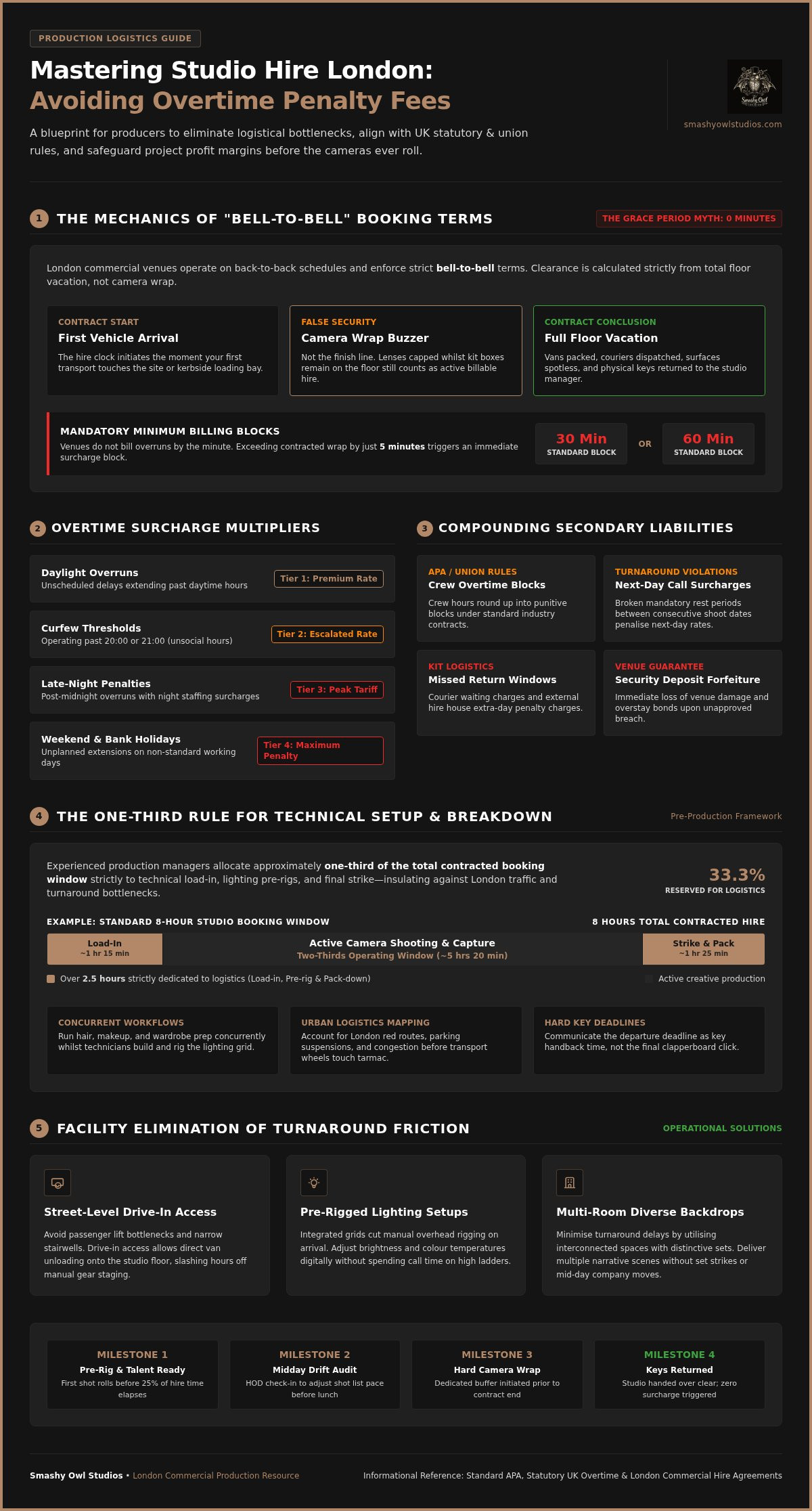
Your project's profit margin rarely disappears in front of the lens. It vanishes on the pavement during pack-down. Every producer knows the sinking feeling of watching the clock tick past wrap whilst kit boxes clutter a narrow hallway and London traffic stalls your vans outside. When arranging studio hire London avoiding overtime penalty fees comes down to eliminating logistical bottlenecks before the cameras ever roll.
Unexpected venue surcharges and compounding crew overtime can quietly erode an otherwise profitable campaign. You shouldn't have to rush complex lighting setups just to dodge a painful final invoice. In this guide, we cover call-sheet scheduling, streamlined strike workflows and how choosing a space with drive-in access and a clear hourly structure keeps you within contracted hours in 2026.
Table of Contents
Understanding London Studio Overtime Penalty Fees and Contract Clauses
Studio overtime penalty fees are premium surcharges levied the moment a production exceeds its contracted rental window. London commercial studios operate on tight turnarounds, with back-to-back bookings and maintenance schedules. Studio hire London avoiding overtime penalty fees therefore requires a precise understanding of the mechanics in your hire contract.
Venue hire agreements universally apply "bell-to-bell" booking terms. Your time starts when your first vehicle touches the site and finishes only after the last crew member exits a spotless stage. London venues do not bill overruns by the minute. Instead, contracts enforce mandatory minimum billing blocks, typically billing late departures in full 30-minute or 60-minute increments. Exceeding your contractual wrap by merely five minutes triggers an entire additional block at premium rates.
Standard Overtime Surcharge Multipliers in London
Overtime rates escalate sharply above standard daytime rates. Venues penalise unscheduled delays because managers must keep staff on site and adjust logistical operations. Most hire agreements apply steep surcharge multipliers:
Daylight overruns: Premium rates apply to unscheduled delays extending beyond contracted daytime hours.
Curfew thresholds: Overtime rates jump significantly after 20:00 or 21:00 to account for unsocial operating hours.
Late-night penalties: Post-midnight overruns routinely command peak surcharge tiers, reflecting nighttime staffing premiums.
Weekend extensions: Unplanned delays on weekends or bank holidays carry elevated surcharge percentages across the city.
The Distinction Between Grace Periods and Billable Overrun
Informal grace periods are a dangerous production myth. While a studio manager might grant five minutes for a final sweep, contracts do not recognise informal buffer windows as working time. Venues calculate clearance strictly from total floor vacation, not camera wrap. If kit remains on the floor or a courier van blocks the bay, your hire clock keeps running. Always distinguish between pre-arranged overtime booked in advance and unapproved emergency overruns, which incur maximum penalty tariffs.
Hidden Secondary Costs of Overrunning Your Call Sheet
Studio venue penalties represent only a fraction of the true overrun cost. When shoots slip past agreed times, secondary financial liabilities stack rapidly. Crew overtime kicks in automatically. Under APA and union standards, crew hours round up into punitive blocks, while broken turnaround rules penalise following-day call times. Sound daily call sheet scheduling prevents these spiralling liabilities, including courier waiting charges, missed external gear return windows, and the immediate forfeiture of venue security deposits.
Pre-Production Scheduling: Calculating True Load-in and Strike Durations
A realistic production schedule treats arrival and pack-down with equal priority to shooting. Too many productions draft call sheets around best-case capture and reserve minimal time for unloading or packing vans. Avoiding overtime begins in pre-production, with disciplined buffers that absorb unexpected delays.
Every call sheet must communicate hard departure deadlines clearly to every department head. If your contracted hire ends at 19:00, that is not your camera wrap time. It represents the precise moment the studio keys return to the venue manager, with vans packed and surfaces cleared. Aligning your timeline with established UK statutory overtime rules keeps production compliant whilst insulating your margins against expensive overrun penalties.
The One-Third Rule for Technical Setup and Breakdown
Experienced production managers adhere to the one-third rule. Allocate approximately one-third of your total booking window strictly to technical load-in, lighting pre-rigs, and the final strike. In an eight-hour booking, that means reserving over two and a half hours purely for logistics. Map gear staging against kerbside loading access, red routes, and congestion before wheels touch tarmac. Run hair, makeup, and wardrobe prep concurrently whilst technicians build the lighting grid. To explore complete timeline templates across different space configurations, review our guide to photo studio hire London.
Structuring an Airtight Shoot-Day Call Sheet
Momentum dictates punctuality. Sequence your most complex hero setups first thing in the morning when crew energy peaks and technical focus is sharpest. Build firm time checkpoints throughout the schedule:
Morning checkpoint: Confirm first camera roll within ninety minutes of doors opening.
Midday review: Audit captured setups against scheduled milestones before lunch breaks.
Hard camera wrap: Call final cut at least forty-five minutes before contracted departure.
That final buffer guarantees sufficient time for cable coiling, set sweeping, and vehicle loading without frantic last-minute panic.
Managing Client Expectations and Shot List Scope
Last-minute creative ambition frequently causes schedule drift. Protect the timetable by sorting shot lists into essential hero deliverables and optional b-roll. Give the producer clear authority on set to cut secondary setups if morning scenes run long, and explain the cost of unapproved schedule creep to commercial clients early.
Selecting London Studio Facilities That Eliminate Turnaround Friction
Venue architecture dictates your pack-down speed. Even the sharpest schedule buckles when your team must haul heavy flight cases down narrow stairwells or through cramped doorways, so choose a space that suits swift gear transit.
Check access routes and interior layout before you book. A space that makes your team work harder adds hours of labour, which raises the fatigue risks covered by UK statutory overtime rules and the HSE guidance on managing working hours and fatigue. Our guide to Film Location Hire London helps you judge spaces on logistics.
Drive-In Access Versus Narrow Kerbside Load-In
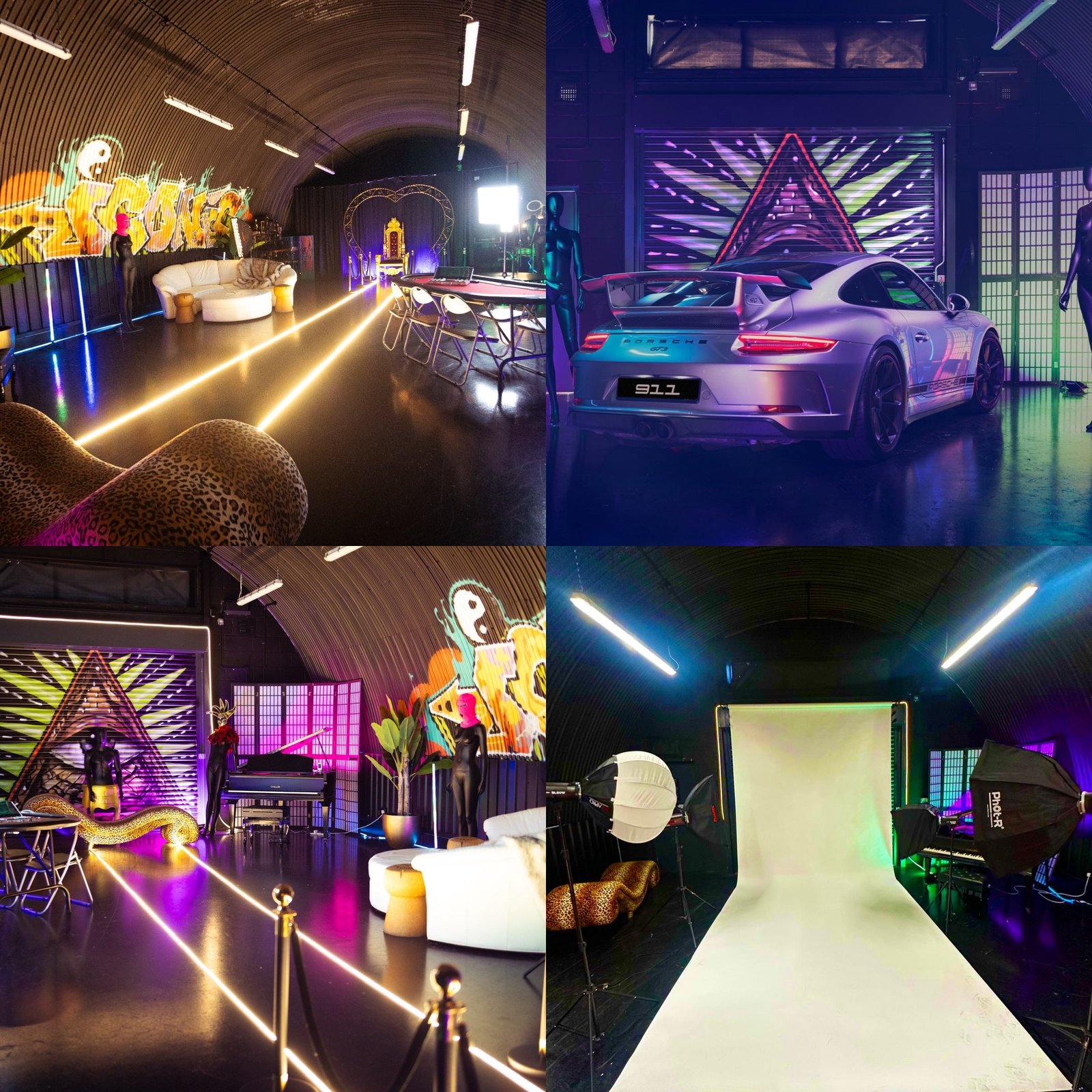
London street loading is notoriously fraught. Red routes, tight parking bays and restrictive council loading windows can delay your arrival. The Arch offers drive-in vehicle access, so you can bring kit straight onto the studio floor on level ground, avoiding lifts, corridors and long carries. Drive-in access is an optional upgrade at £60 per hour, with a 3-hour minimum, and must be requested before booking.
Rigging every light, stand and cable by hand eats into your hired slot before a single frame is captured. Our spaces are hired dry, so you bring your own crew and team. Lighting equipment is provided in the Arch:
Dry hire stages arrive as empty shells. Every light fixture, C-stand, distribution box, and safety bond requires manual rigging, testing, and eventual teardown. This manual process consumes valuable hours of your hired slot before a single frame is captured:
Arch lighting: RGB lighting is provided in the Arch, so there is less to collect and carry in.
Your own kit: You are welcome to bring your own props, equipment and lighting too.
Planning: Allow time in your call sheet for rigging and de-rigging whatever you bring.
Multi-Set Venues That Minimise Set Re-Dressing
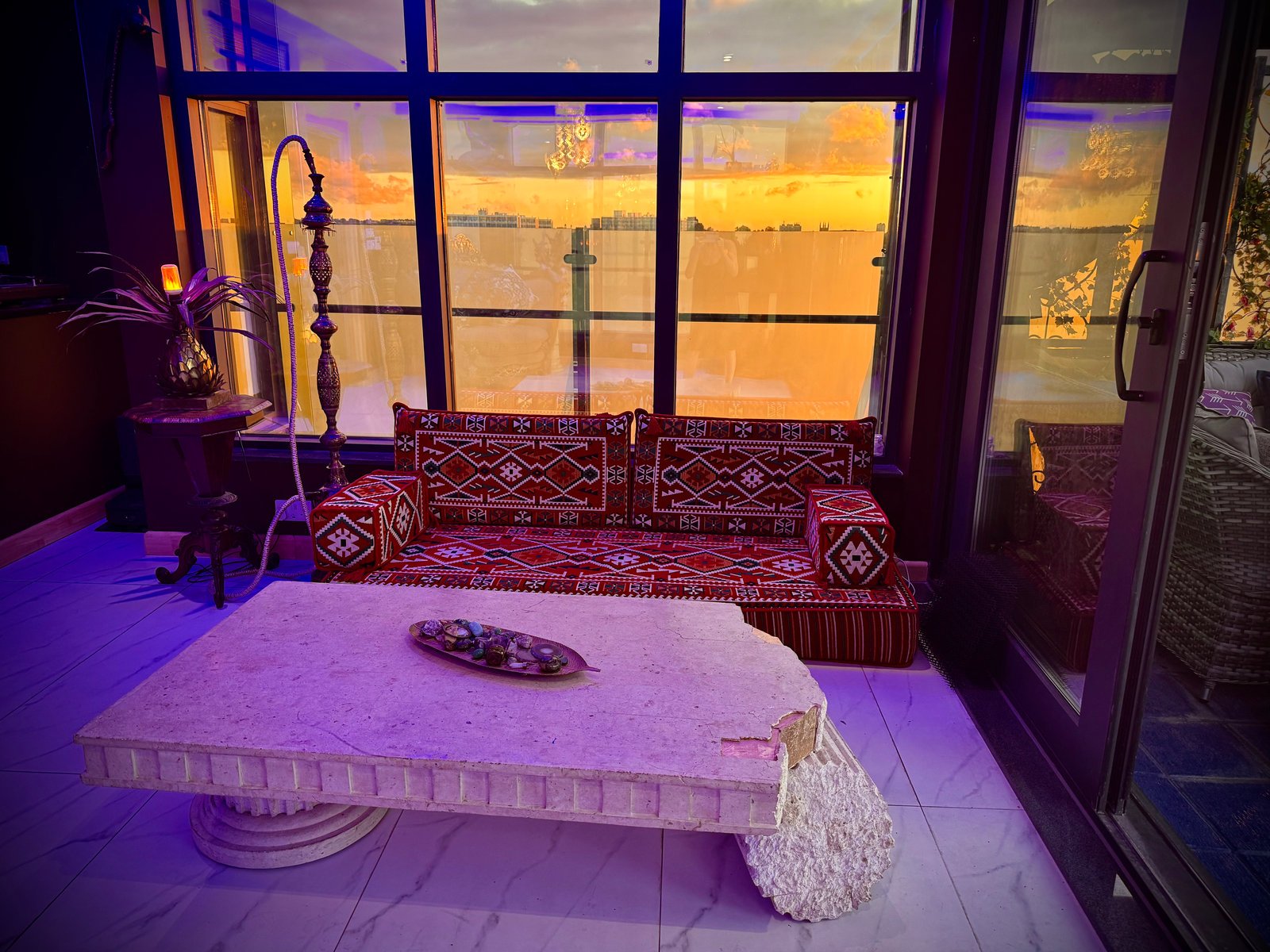
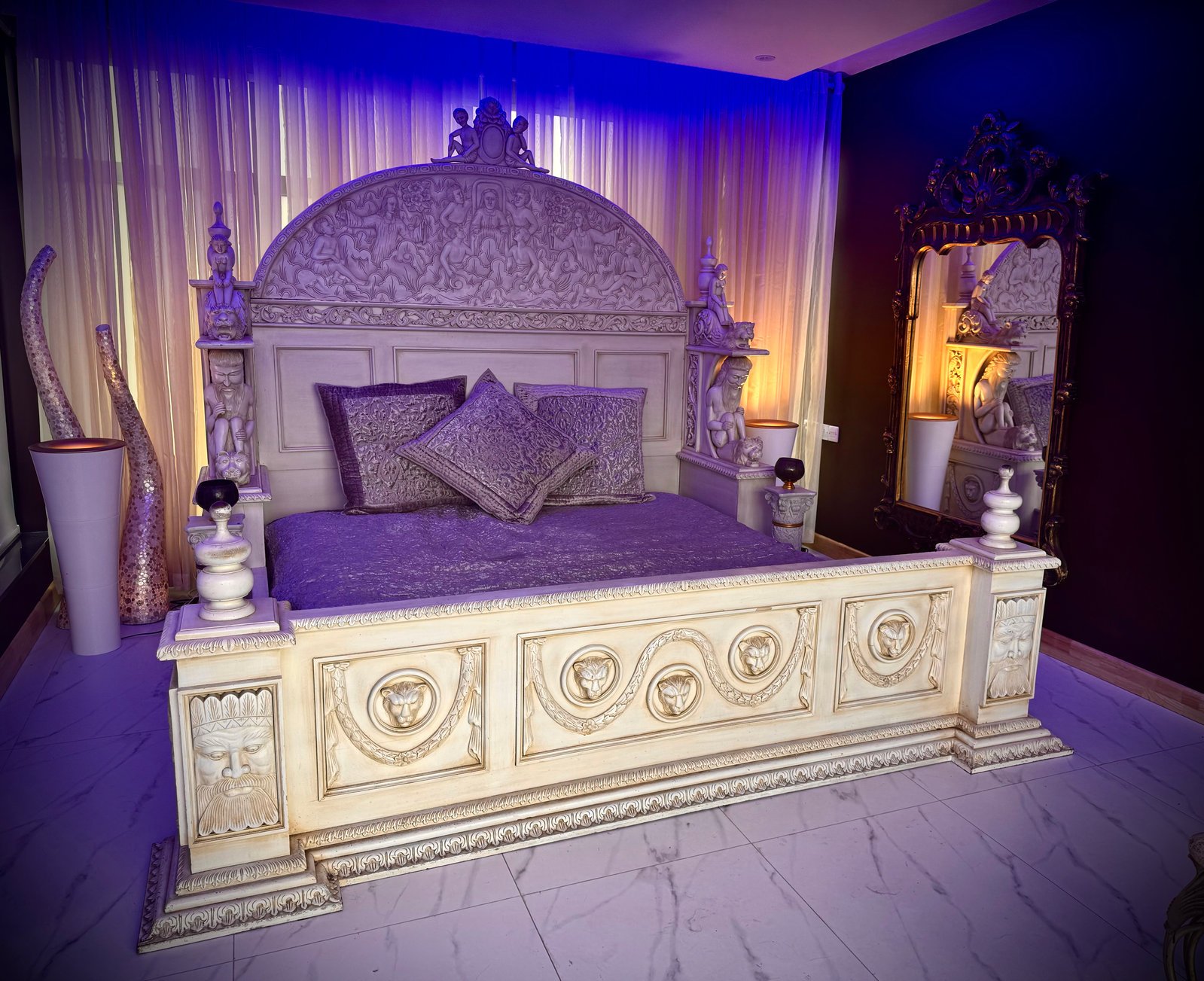
Constantly redressing a single backdrop drains momentum while talent waits. Our two spaces, roughly 3 minutes' drive apart, give you two completely different looks in one day, and the luxury penthouse studio London offers luxury interiors, a heated rooftop hot tub and panoramic skyline views. Both spaces can be hired on the same day at discounted rates.
On-Set Time Management Tactics for Production Directors
Disciplined floor management maintains creative momentum while keeping track of elapsed time. Even the most carefully drafted call sheet collapses if nobody supervises the floor, so clear communication and proactive timekeeping matter throughout the shoot day.
Creative directors naturally focus on framing, performance, and aesthetic nuances. However, lost minutes accumulate silently between takes. Without real-time intervention, a five-minute delay on your opening look expands into an hour-long overrun by sunset. Running a punctual floor requires active structural checks that monitor progress against scheduled milestones.
Appointing a Dedicated Floor Timekeeper
Appoint an assistant or your first assistant director with exclusive authority over floor timekeeping. This individual must remain entirely detached from creative choices. Their sole responsibility is protecting the timetable:
Vocal countdowns: Announce regular checkpoints at thirty, fifteen, and five minutes prior to scheduled scene transitions.
Creative discipline: Interrupt lingering discussions between takes to keep talent and clients aligned with core shot deliverables.
Scene transitions: Signal setup switches immediately once the primary brief frames are confirmed on the monitor.
Implementing Rolling Strikes Throughout the Shoot Day
Never wait for final camera wrap to start packing. Begin rolling strikes as individual scenes conclude: de-rig unused fixtures, coil extension leads and pack peripheral modifiers once your team moves away from a lighting set-up. Return surplus wardrobe rails and unused props to transport boxes by mid-afternoon, so only primary camera and lighting gear remains when the director calls final cut.
Conducting Rapid Protocol for Set Reset and Waste Removal
Handovers often fall apart during the final cleanup. Spaces need to be returned in their original condition, so clear discarded gaffer tape, packaging and waste before the clock runs down. Assign two crew members to sweep floors and return furniture to its starting layout twenty minutes before wrap.
Flexible Booking Strategies and Smashy Owl Studios Solutions
Strategic booking decisions provide a buffer against unpredictable London transport. Because our spaces are hired by the hour, you can match your booking to a realistic production schedule instead of paying for a full day you do not need.
Booking Adequate Buffer Windows Versus Gambling on Overtime
Scheduling an extra contracted hour at the outset is more economical than risking emergency overtime. We cannot guarantee last-minute extensions if another booking follows your slot. Securing an extra hour upfront keeps your crew relaxed and allows an orderly strike.
Maximising Efficiency at Smashy Owl Studios Near Oval
Smashy Owl Studios is a location hire business near Oval station in Camberwell, SE5, with two spaces roughly 3 minutes' drive apart. Our headline space is the Shangri-L'Arche Blackout Studio (the Arch): a converted commercial archway, fully blackout, with drive-in vehicle access, a stage, RGB lighting, a neon runway, a baby grand piano, a white 3x3m Colorama and more. Drive-in access lets you bring kit straight onto the floor, cutting kerbside loading friction. Hire is by the hour with no minimum booking, and you hire the space dry, bringing your own crew and team. The Shangri-La Penthouse offers luxury interiors, a rooftop hot tub and panoramic London skyline views. You can even split a shoot across both locations for two different looks in one day, with no company move across London. See our unique shoot location London guide for more.
Negotiating Clear Terms and Overtime Contingencies in Advance
Proactive communication prevents costly billing shocks before wrap. Review your hire agreement thoroughly to confirm how the venue defines completed vacation. Implement three proactive measures:
Morning inquiry: Ask us at load-in whether the schedule permits an extension if required.
Overrun protocol: Set a threshold, such as two hours before wrap, to tell us if an overrun seems probable.
Hourly buffers: Book an extra hour on top of your planned shoot time to protect project margins.
To reserve your dates, see current rates and book directly at smashyowlstudios.com.
Master Your Production Timeline and Protect Your Budget
Protecting your margins takes proactive scheduling, disciplined floor management and a space that lets you load in quickly. Realistic technical buffers and rolling strikes help your crew wrap smoothly within contracted hours.
Smashy Owl Studios is a location hire business near Oval station in Camberwell, SE5, with two spaces roughly 3 minutes' drive apart: the Shangri-La Penthouse and the Shangri-L'Arche Blackout Studio (the Arch). The Arch is a fully blackout converted archway with drive-in vehicle access, so vans can load close to the set, and lighting equipment is provided there. Both spaces are available for hourly hire with no minimum booking, rather than a full-day minimum. You hire the space dry and bring your own crew and team. Book at smashyowlstudios.com or email bookings@smashyowlstudios.com.
Frequently Asked Questions
What is considered overtime in a London photo or film studio?
Overtime begins the exact minute your contracted hire period finishes. London commercial venues operate on bell-to-bell terms, meaning your booking encompasses load-in, shooting, cleaning, and complete pack-down. If crew members, vehicles, or equipment cases remain on site past the agreed departure threshold, the venue logs an overrun. Most contracts round these infractions up to the nearest thirty or sixty minutes.
How much are standard studio overtime penalty fees in London?
Overtime charges across London typically carry steep premiums well above standard hourly daytime rates. Evening extensions crossing into unsocial operating hours after 20:00 incur higher tariffs, whilst post-midnight overruns command maximum unsocial multipliers. Because studios bill late departures in non-negotiable 30-minute or 60-minute blocks, exceeding your hire window by even ten minutes can trigger a full hour of premium penalty surcharges.
Can I extend my studio hire booking on the day of the shoot?
You can occasionally extend on the day, but it depends entirely on venue availability. Studios cannot approve extensions if another production, evening event, or scheduled maintenance crew follows your slot. Requesting additional time at the start of the shoot is always safer than gambling on last-minute clearance. When managing studio hire London avoiding overtime penalty fees relies on locking in realistic scheduled windows before arriving on set.
Does studio hire include load-in and pack-down time?
Yes, London studio hire agreements almost universally include load-in, gear rigging, and pack-down within your contracted slot. The clock starts the moment your first vehicle arrives and ends only when the space is cleared and inspected. You cannot begin loading gear onto the floor before your scheduled start time, nor can you linger inside the facility after your contracted wrap time without incurring overtime penalties.
What happens if London traffic makes my crew arrive late to the studio?
Venues do not shift booking windows forward due to external transit delays. Your contracted finish time remains fixed regardless of traffic congestion, tube disruptions, or parking delays. If your crew arrives an hour late, that lost time comes directly out of your shooting schedule. Professional production teams account for Central London gridlock by building generous transit buffers into their morning call sheets to protect end-of-day wrap times.
Are overtime fees charged if only the camera crew is packed up?
Yes, studios bill overtime based on complete venue vacation rather than camera wrap. If lighting stands remain rigged, makeup teams are still packing kits, or hired props clutter the floor, the studio considers the booking active. Even empty flight cases stacked in loading corridors keep the hire clock running. All departments must be completely packed, rubbish cleared, and keys handed back to avoid late fees.
How can lighting provided in the Arch help me avoid overtime penalties?
The Arch includes lighting equipment, so there is less to collect and carry in, and your team spends less time rigging and de-rigging during wrap. You are also welcome to bring your own lighting. For producers planning studio hire in London and avoiding overtime penalty fees, a space with lighting provided is a real advantage.
Comments